Cabins are where solar makes the most sense: no utility hookup to compete with, modest loads, and every watt you generate is one you don't haul in as fuel. Your first decision is architecture. Based on manufacturer specs and public reviews.
Step 1: estimate your daily energy
| Load (example) | Watts | Hours/day | Wh/day |
|---|---|---|---|
| 6 LED lights | 54 | 5 | 270 |
| Efficient fridge (average) | 40 | 24 | 960 |
| Water pump | 300 | 0.5 | 150 |
| Phones + laptop | 70 | 3 | 210 |
| Total | 1,590 |
Illustrative figures. Use your own device labels or a watt meter.
Step 2: size panels and battery
1,590 ÷ (3 × 0.75) ≈ 710 W of panels
1,590 × 2 ÷ 0.9 ≈ 3,500 Wh
Option A: all-in-one power station
A 2 to 4 kWh station plus folding or fixed panels is the plug-and-play route: no wiring, take it home in winter. The 2000 Plus grows with battery packs; the DELTA Pro 3 offers 2,600 W of solar input and 240V.
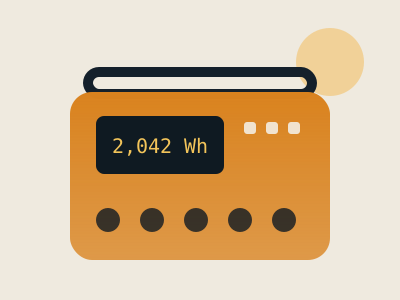
Expandable mid-size home backup
Jackery Explorer 2000 Plus
Best for: Expandable mid-size home backup
| Capacity | 2,042 Wh |
|---|---|
| AC output | 3,000 W |
| Voltage | 120V (240V by pairing two units) |
| UPS switchover | See spec sheet |
| Weight | See spec sheet |
| Cycle life | See spec sheet |
| Chemistry | LFP |
| Expansion | 2 to 24 kWh with battery packs (retailer listing) |
Strengths
- 3,000 W continuous in a mid-size unit
- Modular: grows from 2 kWh up to 24 kWh
Watch-outs
- 240V requires two units linked
- Several specs need checking on Jackery's current sheet before you buy
Specs: manufacturer / retailer spec sheets (source 1 · source 2). Prices change daily, so we do not print them.
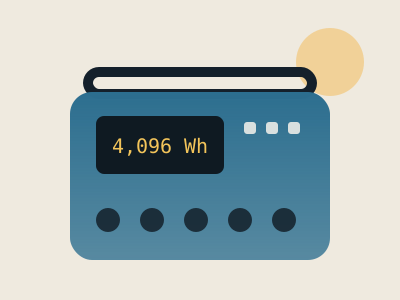
Whole-home circuits, 240V loads, long outages
EcoFlow DELTA Pro 3
Best for: Whole-home circuits, 240V loads, long outages
| Capacity | 4,096 Wh |
|---|---|
| AC output | 4,000 W (surge 8,000 W) |
| Solar input | 2,600 W |
| Voltage | 120V / 240V |
| UPS switchover | < 10 ms |
| Weight | 113.5 lb (51.5 kg) |
| Cycle life | 4,000 to 80% |
| Chemistry | LFP |
| Outlets | NEMA 5-20R, TT-30, L14-30, 6-20 |
| Parallel | Up to 3 units, 12,000 W combined (per retailer spec) |
Strengths
- 240V output for well pumps and dryers without a second unit
- Very short listed UPS transfer (< 10 ms)
- 2,600 W combined solar input across two PV ports
Watch-outs
- 113.5 lb: it rolls, it is not carried
- Whole-home use needs a transfer switch or Smart Home Panel 2 installed by an electrician
Specs: manufacturer / retailer spec sheets (source 1). Prices change daily, so we do not print them.
Option B: DIY 12V system
Panels → MPPT charge controller → LiFePO4 battery bank → inverter. It is repairable part by part and scales cheaply. For 700 W of panels at 12V, a 50 A controller fits (see MPPT guide); for a 3.5 kWh bank, three 12V 100Ah LiFePO4 batteries in parallel (see LiFePO4 guide). Above roughly 1.5 to 2 kW of inverter, a 24V or 48V system keeps currents and cable sizes manageable.

12V systems up to roughly 700 W of panels
Victron SmartSolar MPPT 100/50
Best for: 12V systems up to roughly 700 W of panels
| Voltage | 12/24V battery |
|---|---|
| Max PV voltage | 100 V |
| Charge current | 50 A |
| Connectivity | Bluetooth (VictronConnect app) |
Strengths
- Same platform as the 100/30 with more current
- Fits a typical 12V cabin with 2 to 3 panels
Watch-outs
- 100 V PV ceiling: plan strings in parallel or 2S, check cold-weather Voc
Specs: manufacturer / retailer spec sheets (source 1). Prices change daily, so we do not print them.
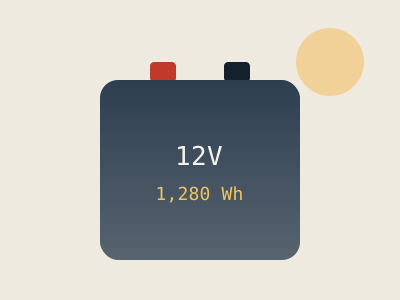
Cabin or RV bank where support matters
Battle Born BB10012 (12V 100Ah)
Best for: Cabin or RV bank where support matters
| Capacity | 1,280 Wh |
|---|---|
| Voltage | 12.8V nominal |
| Weight | See spec sheet |
| Cycle life | See spec sheet |
| Chemistry | LiFePO4 |
| Capacity | 100 Ah |
| Made by | Dragonfly Energy (USA) |
Strengths
- US-assembled, long-established in RV/off-grid market
Watch-outs
- Premium price class; compare warranty terms
Specs: manufacturer / retailer spec sheets (source 1). Prices change daily, so we do not print them.
Transfer switches, power inlets, sub-panels and hard-wired batteries change your home's wiring. In most places this legally requires a licensed electrician and sometimes a permit and utility notification. This page explains the options so you can talk to an electrician, it is not installation instructions.
Fusing, cable sizing, grounding and battery enclosures are where DIY systems go wrong. Have a qualified electrician design or check any fixed installation.
FAQ
How big a solar system does a cabin need?
Estimate daily energy (Wh) for lights, fridge, pump, devices. Divide by your location's winter peak sun hours and a real-world factor around 0.75 to size the array. Size the battery for the number of cloudy days you want to ride through.
All-in-one or DIY?
All-in-one stations are faster to set up and portable; DIY systems are more repairable, more customisable and usually scale more cheaply, but need electrical knowledge and, for fixed wiring, a qualified installer.
Can I charge LiFePO4 batteries below freezing?
Generally not without protection. Many LiFePO4 batteries must not be charged below about 0 °C (32 °F) unless they have built-in heating or low-temperature charge protection. Check the specific model.
Do I need permits for a cabin solar system?
Permanent installations often fall under local electrical codes and may require permits and inspection even off-grid. Check with your local authority.