If you depend on a CPAP or other medical device, confirm power requirements and approved accessories with the device manufacturer and your clinician, and keep a backup plan. Our numbers are planning estimates, not medical advice.
For CPAP users, an outage is not an inconvenience; it is a night without therapy. The good news: a CPAP is a small load, and even a modest station can cover several nights if you plan for the humidifier. Based on manufacturer specs and public reviews; your device's documentation is the authority.
Calculate your nights per charge
- Find your CPAP's real draw: measure a full night with a plug-in watt meter (it gives Wh directly), or check the manual.
- Apply the station's usable share: about 85% on AC, typically more via an approved DC cord.
Example: 1,024 Wh × 0.85 ÷ (40 W × 8 h) ≈ 2.7 nights · with humidifier at 90 W ≈ 1.2 nights
40 W and 90 W are illustrative, not measured values for any specific CPAP.
What matters in a CPAP station
- UPS switchover: if the station sits between wall and CPAP, a short switchover avoids waking you when power drops. The DELTA 3 Plus lists under 10 ms.
- Quiet operation: it sits next to your bed. Check public reviews for fan behaviour at low loads.
- DC output: a 12V car-style port or USB-C PD lets you use manufacturer-approved DC cords.
- Recharge path: fast wall charging and a solar option for multi-day outages.
| Model | Capacity | Output | Solar in | Voltage | UPS |
|---|---|---|---|---|---|
| EcoFlow DELTA 3 Plus | 1,024 Wh | 1,800 W | 500 W | 120V | < 10 ms |
| Jackery Explorer 1000 v2 | 1,070 Wh | 1,500 W | check | 120V | about 20 ms |
| BLUETTI AC180 | 1,152 Wh | 1,800 W | 500 W | 120V | 20 ms |
| EcoFlow RIVER 3 | 245 Wh | 300 W | check | 120V | See spec sheet |
"check" = not confirmed on the sources we used; verify on the manufacturer page before buying.
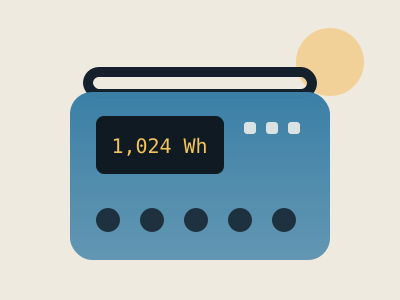
Best bedside UPS
EcoFlow DELTA 3 Plus
Best for: UPS for home office, CPAP, router
| Capacity | 1,024 Wh |
|---|---|
| AC output | 1,800 W (surge 3,600 W) |
| Solar input | 500 W |
| Voltage | 120V |
| UPS switchover | < 10 ms |
| Weight | 27.6 lb (12.5 kg) |
| Cycle life | 4,000 to 80% |
| Chemistry | LFP |
| AC charging | 1,500 W, about 56 min |
| X-Boost | 2,200 W for resistive loads |
| Expansion | Optional extra batteries (check EcoFlow for max) |
Strengths
- < 10 ms UPS: the safest pick here for desktop PCs and network gear
- Full recharge from the wall in under an hour
Watch-outs
- Solar figure listed by retailer as 500 W; check EcoFlow for the dual-input total
Specs: manufacturer / retailer spec sheets (source 1). Prices change daily, so we do not print them.

Several nights
Jackery Explorer 1000 v2
Best for: Portable outage kit you can actually carry
| Capacity | 1,070 Wh |
|---|---|
| AC output | 1,500 W (surge 3,000 W) |
| Voltage | 120V |
| UPS switchover | about 20 ms |
| Weight | 23.8 lb (10.8 kg) |
| Cycle life | about 4,000 |
| Chemistry | LFP |
| AC charging | about 1 h 40 min (about 1 h with app emergency mode) |
Strengths
- Lightest ~1 kWh LFP unit in our shortlist (23.8 lb)
- Fast app-enabled emergency charging
Watch-outs
- 1,500 W continuous: no space heaters or big microwaves
- Solar input to check on Jackery's sheet
Specs: manufacturer / retailer spec sheets (source 1). Prices change daily, so we do not print them.
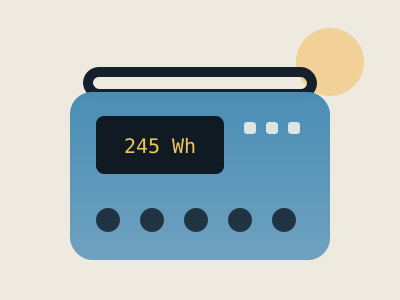
Small and light
EcoFlow RIVER 3
Best for: Router, lights, a single CPAP night (without humidifier)
| Capacity | 245 Wh |
|---|---|
| AC output | 300 W |
| Voltage | 120V |
| UPS switchover | See spec sheet |
| Weight | See spec sheet |
| Cycle life | See spec sheet |
| Chemistry | LFP |
Strengths
- Small enough for a nightstand: router, phone, lights, low-draw CPAP
Watch-outs
- 300 W cap: CPAP heated humidifiers and laptops together can exceed it
Specs: manufacturer / retailer spec sheets (source 1). Prices change daily, so we do not print them.
Run your exact CPAP figures in the runtime calculator.
FAQ
How many watts does a CPAP use?
It varies by model, pressure setting and especially humidifier and heated-tube use. Check your device's manual or power supply label, or measure with a plug-in watt meter for a night. Humidification can multiply consumption.
Can I run a CPAP from a power station's DC output?
Many CPAP manufacturers sell approved DC power cords or converters, which avoid inverter losses and can extend runtime significantly. Use only accessories approved by your device's manufacturer.
Is a power station safe for a medical device?
Power stations output pure sine wave AC, which most devices expect. Still, confirm with the CPAP manufacturer and your clinician, and keep a backup plan for longer outages.
Should I turn off the humidifier during an outage?
It is a common way to extend runtime, but it is a medical comfort and therapy question. Discuss it with your clinician beforehand.